
Climate Fairytales: What We Learned from Adapting the Workshop for Children
Can a fairytale help children explore sustainable mobility – and imagine solutions to the challenges connected with how we move?
In September 2026, we adapted our Climate Fairytales methodology to a new topic and a younger audience. Together with pupils from three Slovenian primary schools, we explored sustainable mobility through storytelling.
The original Climate Fairytales workshop uses fairytales as a creative method for exploring fears and challenges connected with climate change. This time, we experimented with a more specific question: Can the same approach help children explore mobility challenges and imagine possible solutions through fairytales?
Across three workshops, 43 pupils from grades 7–9 created 23 original fairytales. They came from Jurij Vega Primary School Moravče, Dr. Ivan Korošec Primary School Borovnica, and Domžale Primary School.
Workshop structure: From rhymes to magical mobility solutions
The workshops began with getting to know each other and short creative exercises designed to awaken playfulness and imagination. Only afterwards did we introduce the topic of mobility.
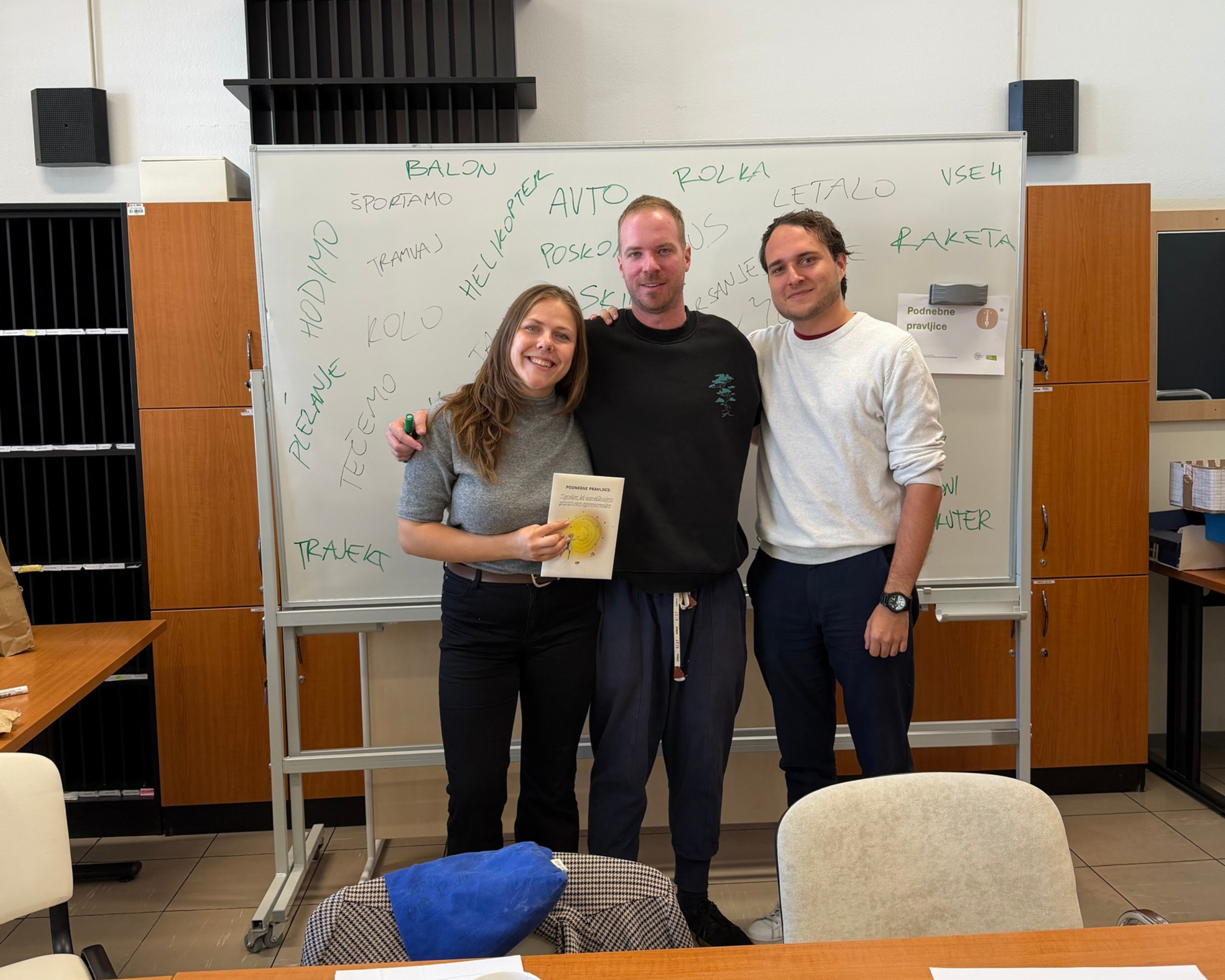
We explored the many ways people move from one place to another and discussed their advantages and disadvantages. In one workshop alone, pupils identified more than 30 different forms of mobility – from walking, cycling and public transport to riding a camel and travelling by combine harvester.
We then returned to the world of fairytales. Together, we explored some of their familiar elements: heroes, challenges, magical helpers, unusual solutions and lessons.
To make the writing process easier, pupils used a simple six-part story framework: Who is the hero? Where does the story take place? What mobility-related challenge does the hero face? Who or what is the magical helper? What is the solution? And what can we learn from the story?
Before writing the complete fairytale, pupils first developed a draft and presented their idea aloud. This created an important intermediate step: facilitators could help when an idea became stuck, while peers could contribute questions and inspiration.
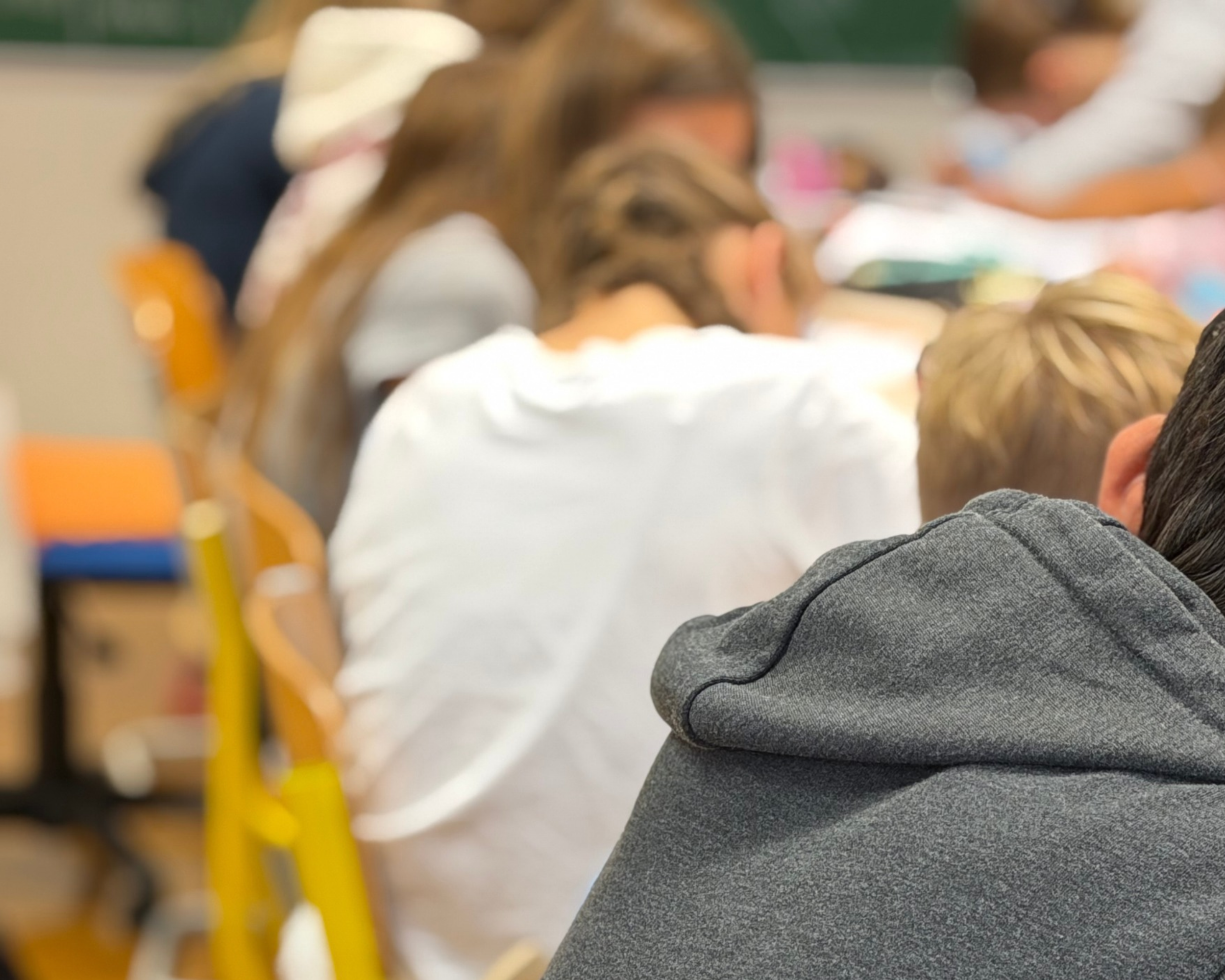
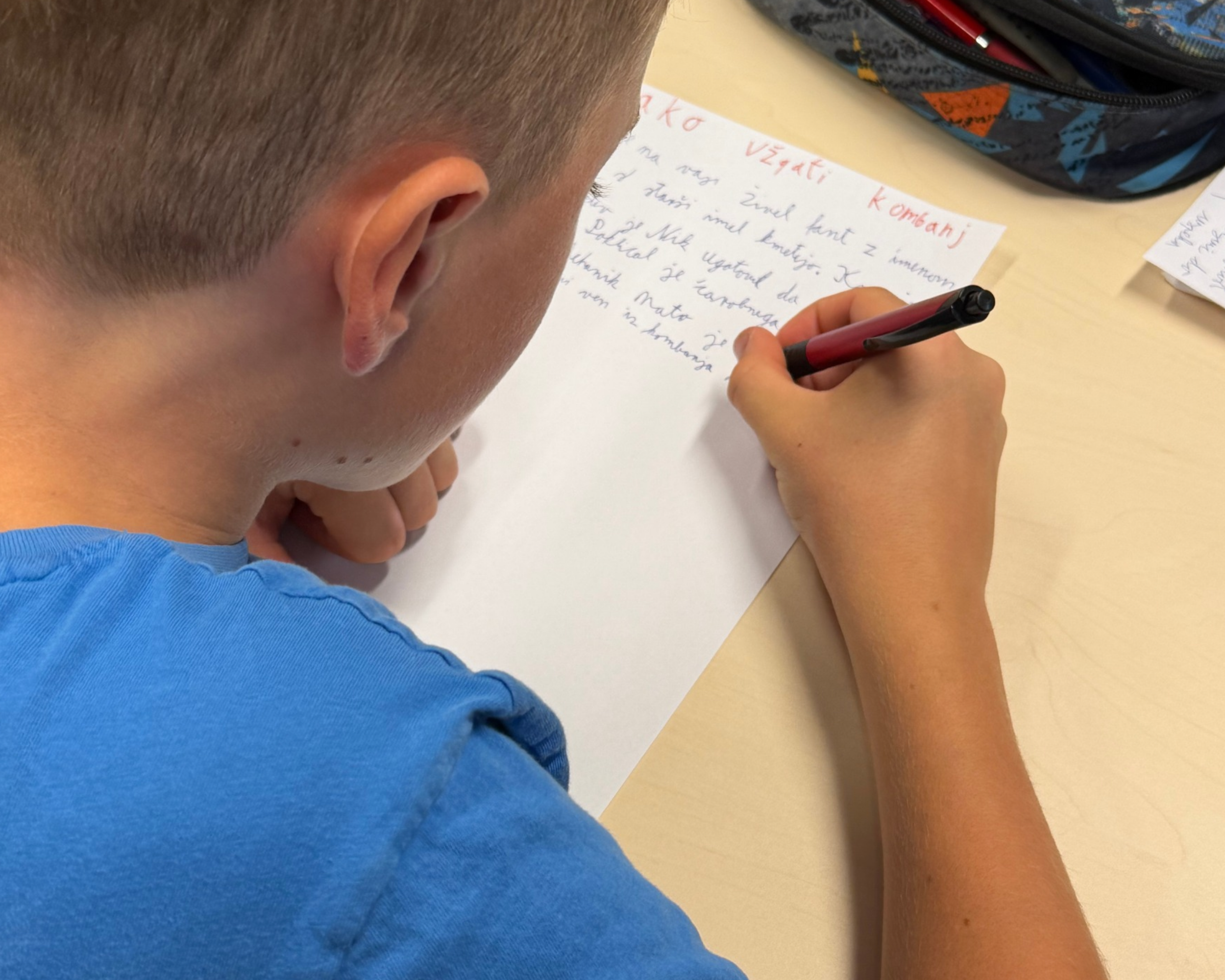
Most pupils worked in pairs. One might write while the other developed ideas or illustrated the story. At the end, the fairytales were read aloud and discussed together.
What did we learn as facilitators?
The three workshops also became a valuable learning experience for us. Adapting a methodology to children is not simply a matter of simplifying the content. The structure, group size, instructions, pace and facilitation all need to change.
These are some of the most important lessons we are taking with us:
1. Smaller groups create space for creativity
For one facilitator, we recommend a maximum of eight children – and ideally around six. Creative writing requires individual attention. Children sometimes need encouragement, help developing an idea or simply someone who listens while they think aloud.
Smaller groups also make it easier to create psychological safety and ensure that quieter participants have space to contribute.
2. Children need structure – even when the task is open
Adults may respond well to an instruction such as “There are no rules – be creative.” For school-age children, this can create uncertainty rather than freedom.
Children are accustomed to working with instructions at school. We therefore learned that creative freedom works better when it is supported by a clear framework: what happens first, what happens next and what the expected output is.
The six-part fairytale framework provided enough structure to get started without prescribing what the story itself should become.
3. Playfulness needs to come before writing
We found it important not to begin immediately with the main task.
Time spent getting to know each other, playing with words, drawing, rhyming and doing short creative exercises is not an introduction to the “real” workshop – it is part of the methodology.
These activities help children move from the structured rhythm of a school day into a more playful mode in which unusual ideas become possible.
4. Working in pairs can unlock participation
Pair work proved particularly interesting. Writing a complete story individually can feel demanding, while working with another person allows children to exchange ideas and divide roles according to their strengths.
One pupil can write, another can generate ideas or illustrate. More importantly, they learn that creativity does not have to be an individual activity – it can emerge through collaboration.
5. Draft first, write later
Before pupils began writing their final fairytales, we asked them to prepare a simple draft and explain their story aloud.
This small step made a considerable difference. By listening to the idea before the writing began, the facilitator could ask questions, identify gaps and help pupils move forward when they were stuck.
For creative workshops with children, we would therefore recommend treating idea development and writing as two separate phases.
6. Breaks matter
Children are used to the rhythm of school lessons and breaks. Creative work also requires considerable concentration.
Rather than trying to maximise every available minute, we learned to build breaks deliberately into the workshop structure. A short pause can restore attention and ultimately make the creative time that follows more productive.
7. Motivation matters when selecting participants
One of the clearest lessons concerned how children enter the workshop.
When participation is perceived primarily as an opportunity to miss regular classes, facilitation becomes considerably more demanding – and children who genuinely want to write and create may receive less attention.
Whenever possible, we therefore recommend inviting children who voluntarily choose to participate, are curious about storytelling or enjoy writing and creative activities.
8. Reading aloud can become an exercise in appreciation
We did not want the final reading to become an evaluation of whose story was “best”.
Instead, after reading the fairytales aloud, we encouraged the group to identify at least five things they liked about each story.
This transformed feedback into another learning activity. Children practised listening carefully, recognising strengths in someone else's work, articulating positive feedback and receiving appreciation for their own creativity.
Fairytales as a way of approaching real-world challenges
The experiment also brought us back to the central idea behind Climate Fairytales.
The methodology was originally developed to use fairytales as a way of approaching climate-related fears and challenges through imagination. Sustainable mobility gave us an opportunity to test what happens when this approach is applied to a concrete sustainability challenge.
A fairytale does not ask children to immediately produce the “correct” answer to a complex problem. Instead, it allows them to create a hero, give the hero a challenge, introduce unexpected helpers and imagine solutions that would not necessarily appear in an ordinary classroom discussion.
And perhaps one of the most encouraging observations came from the pupils themselves: writing a good story can be much easier and faster than they initially imagined.
For us, that is also part of the value of the method. Children do not only explore sustainability – they experience themselves as people capable of imagining, creating and sharing something of their own.
Bring Climate Fairytales to your school or organisation
The September workshops showed us that Climate Fairytales can be adapted not only to different sustainability topics, but also to younger audiences – provided that the facilitation approach is adapted with them.
You can explore the stories and previous editions of the project in our Climate Fairytales Digital Exhibition.
If you are a school, educational organisation, municipality or organisation working with children and young people and would like to explore climate challenges through storytelling, we would be happy to adapt and facilitate a Climate Fairytales workshop for your group.
